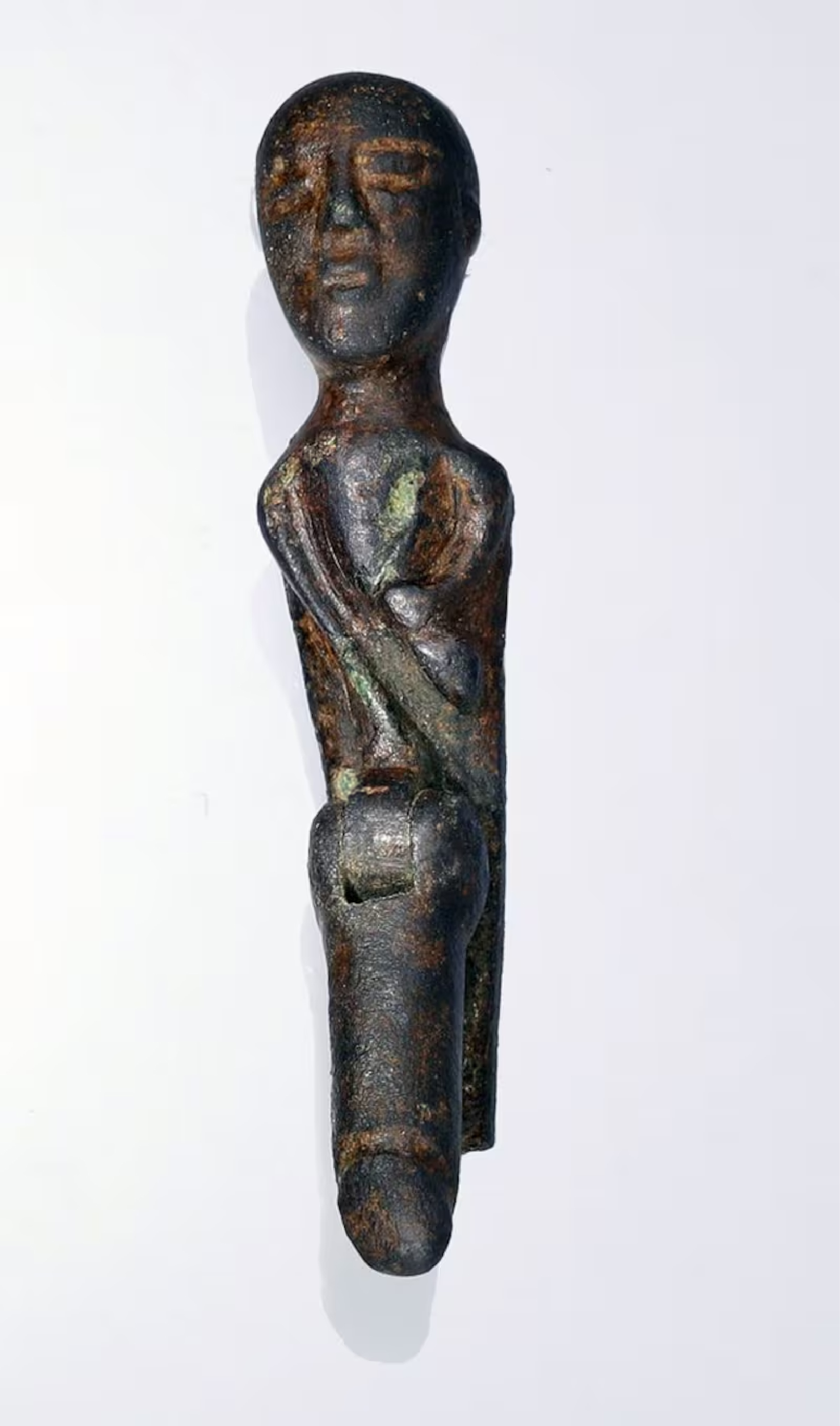
A recent discovery in Haconby, England, of a Celtic bronze figurine from the first century CE demonstrates the potential of historical finds in the most random places.
While exploring a stubble field in the quiet village, a metal detectorist unearthed a small but extraordinary artifact: a two-inch bronze figurine of a nude man with a hinged, oversized phallus. This remarkable find, now known as the “Haconby Celtic Fertility Figure,” was sold for a hammer price of £2,200 at Noonans Mayfair in London to a UK buyer.
Initially mistaken for a split pin, the figurine was later identified as a first-century Celtic representation of a fertility god. Nigel Mills, a coins and artifacts consultant at Noonans, suggested that the figure may have been modeled after Mercury, the Roman god of commerce and communication, as it seems to hold the god's symbolic purse. The male figure, with its hinged oversized phallus, would likely have symbolized good luck and protection against evil spirits. Also, it might have served a functional purpose, acting as a buckle to secure a belt and scabbard for a sword.
Made just 10 inches deep in the soil during a metal detecting rally, this extraordinary discovery adds to the growing evidence that valuable art pieces continue to be uncovered in the most surprising locations.
Source: Noonans
https://www.noonans.co.uk/news-and-events/latest-news/730/

 Languages
 简体中文
 বাংলা
 slovenščina
 繁體中文(香港)
 català
 Bahasa Melayu
 Nederlands
 svenska
 繁體中文(台灣)
 čeština
 Íslenska
 norsk
 suomi
 dansk
 Bahasa Indonesia
 polski
 français
 eesti
 日本語
 português
 Türkçe
 Deutsch
 ქართული
 한국어
 română
 українська
 Italiano
 ελληνικά
 lietuvių
 Русский
 اردو
 اعربي
 עברית
 magyar
 Slovenščina