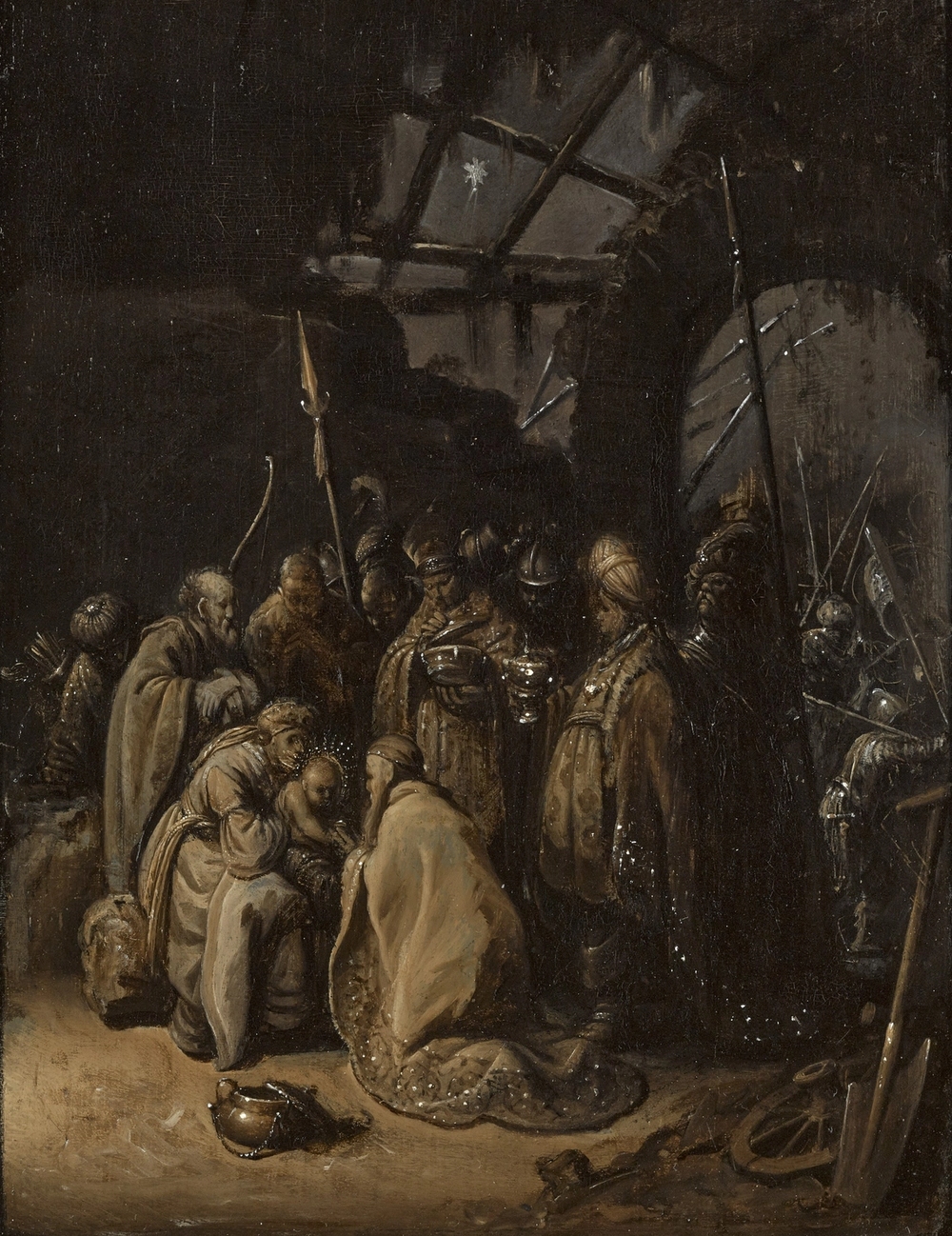
Recently, the art world witnessed the rediscovery of a painting titled The Adoration of the Kings, believed to have been created in 1628, which sold at Sotheby’s in December 2023 for £10.9 million. Initially attributed to the "Circle of Rembrandt" by Christie’s Amsterdam, this artwork appeared in an online auction in 2021 with a modest estimate of €10,000 to €15,000. However, after extensive examination, Sotheby’s specialists reattributed the piece, confirming it as a work by the master himself.
The painting’s provenance dates back to 1955, when Dutch collector Johannes Carel Hendrik Heldring acquired it. After his passing in 1962, it vanished from records, only resurfacing in 1985 and again in an online sale in 2021, where it sold for €860,000.
The small-scale panel, created during Rembrandt's formative years in Leiden, portrays a biblical scene in monochromatic tones. It reflects the trademarks of Rembrandt’s style, featuring dramatic chiaroscuro, emotive facial expressions, and fluid brushstrokes that accentuate the psychological depth of the artwork.
This extraordinary rediscovery is a powerful reminder that unknown works by Rembrandt may still be hidden in private collections or mislabeled around the world. Art history is full of surprises, and masterpieces like this can resurface when least expected, offering insights into the artist’s legacy.

 Languages
 简体中文
 বাংলা
 slovenščina
 繁體中文(香港)
 català
 Bahasa Melayu
 Nederlands
 svenska
 繁體中文(台灣)
 čeština
 Íslenska
 norsk
 suomi
 dansk
 Bahasa Indonesia
 polski
 français
 eesti
 日本語
 português
 Türkçe
 Deutsch
 ქართული
 한국어
 română
 українська
 Italiano
 ελληνικά
 lietuvių
 Русский
 اردو
 اعربي
 עברית
 magyar
 Slovenščina