Carlos Enriquez (1900-1957)
Get a Enriquez Certificate of Authenticity for your painting (COA) for your Enriquez drawing.
For all your Enriquez artworks you need a Certificate of Authenticity (COA) in order to sell, to insure or to donate for a tax deduction.
Getting a Enriquez Certificate of Authenticity (COA) is easy. Just send us photos and dimensions and tell us what you know about the origin or history of your Enriquez painting or drawing.
If you want to sell your Enriquez painting or drawing use our selling services. We offer Enriquez selling help, selling advice, private treaty sales and full brokerage.
We have been authenticating Enriquez and issuing certificates of authenticity since 2002. We are recognized Enriquez experts and Enriquez certified appraisers. We issue COAs and appraisals for all Enriquez artworks.
Our Enriquez paintings and drawings authentications are accepted and respected worldwide.
Each COA is backed by in-depth research and analysis authentication reports.
The Enriquez certificates of authenticity we issue are based on solid, reliable and fully referenced art investigations, authentication research, analytical work and forensic studies.
We are available to examine your Enriquez painting or drawing anywhere in the world.
You will generally receive your certificates of authenticity and authentication report within two weeks. Some complicated cases with difficult to research Enriquez paintings or drawings take longer.
Our clients include Enriquez collectors, investors, tax authorities, insurance adjusters, appraisers, valuers, auctioneers, Federal agencies and many law firms.
We perform Carlos Enriquez art authentication, appraisal, certificates of authenticity (COA), analysis, research, scientific tests , full art authentications. We will help you sell your Carlos Enriquez or we will sell it for you.
Painter and writer Carlos Enriquez is perhaps one of the least known of the great Cuban masters. In his home country, he is regarded as one of the greatest artists of all time, yet even today his work is still generally unknown world wide. He was a leader in the Cuban avant-garde through his work with the marriage of painting and his writing.
Enriquez had very little artistic training, and in fact, initially wanted to be a writer. He left Cuba and graduated from business school in Philadelphia in 1924. He had taken some art instruction in high school, as well as at an academy in Pennsylvania, but most of his artistic training came from traveling abroad. After graduation, he moved back to Cuba with his wife, Alice Neel (also a painter), where he worked at a coal mine and painted in his spare time. From 1927-1933, Enriquez traveled extensively and lived in New York, Paris and Madrid. He visited museums and became friends with the Surrealists in Paris.
With American schooling and European art instruction tucked in his back pocket, Enriquez returned to Cuba in 1934. In the tradition of the vanguards artists of this time, his return to Cuba spawned a new subject for the painter; his home culture and history. Typically, he would paint scenes of whimsical Cuban landscapes, nudes, portraits, and Cuban lifestyles. He would paint portraits of friends, as well as peasants and wildlife, but it was his whimsical paintings that are the most remarkable.
His earlier work had a very dark color palate and his style was very rounded and soft, sometimes taking on elements similar to Cubism, such as “Desnudo” (1930) and “Roda Pesquera de Santander” (1930).


These paintings were created during his stay in Europe. There is no doubt that more work of his similar to this exists elsewhere in either Paris or Madrid. These were painted before he gained much notoriety and it was likely that he sold work like this to support himself in Europe.
It was very typical of Enriquez to experiment with many different mediums from crayon to gouache, ink, graphite and oil, and used different surfaces such as paper, canvas and board. He also had a very distinctive signature, which he would usually sign at the bottom right hand corner of his paintings, though he would also sign on the left, and was signed at an almost 45 degree angle.
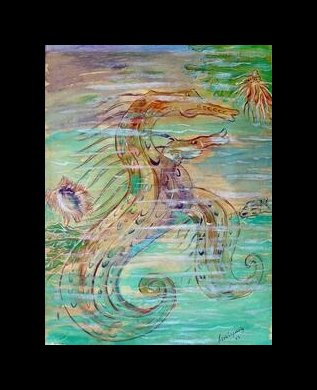
Toward the end of his career, he began to embrace Surrealism even more, and took on the bright and sometimes even pastel color palate of the Impressionists. Enriquez was always painting with some sort of whimsy in mind, whether it was horses or a mystical landscape or seahorses. His themes also often take on mythological Creole and ethnic elements, which were certainly spawned from his trips to Mexico and Haiti.
One of his best known paintings, “Paisaje” (1943) is a great example of his landscape treatment. Birds of paradise and palmetto fronds are painted in bright Caribbean colors with an Impressionistic hand.

Wildlife was also a frequent theme in Enriquez paintings. In particular, he painted horses and sea creatures a great deal. One great example is “Caballitos de Mar” (1942).
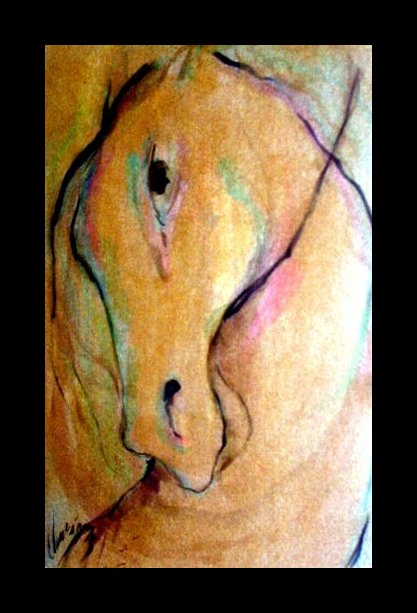
Though usually painting in a whimsical style, Enriquez was not blind to the political turmoil happening in his country. He also used his artistic talent to express his political and social ideas through his depictions of the Cuban peasantry and guerilla fighters. Expressionist-style paintings and sketches such as “Caballos en Combate” (1953) are perfect examples of his politically fueled pieces.

Enriquez style was very fluid, and though he considered an Expressionist, he combines many different styles to create one of his own. He was well published and wrote many accompaniments to his paintings, and illustrated many books as well. Enriquez also completed murals and frescoes, one of which was destroyed. Toward the last decade of his career, his work began to suffer and he didn’t paint as much due to sickness and alcoholism.
Today, the work of Carlos Enriquez is housed in Cuba, Europe and the America’s. His home in Cuba has been converted into a museum of his work, and many of his paintings are owned privately world wide.