Sir George Hayter (1792 – 1871)
Get a Hayter Certificate of Authenticity for your painting (COA) for your Hayter drawing.
For all your Hayter artworks you need a Certificate of Authenticity (COA) in order to sell, to insure or to donate for a tax deduction.
Getting a Hayter Certificate of Authenticity (COA) is easy. Just send us photos and dimensions and tell us what you know about the origin or history of your Hayter painting or drawing.
If you want to sell your Hayter painting or drawing use our selling services. We offer Hayter selling help, selling advice, private treaty sales and full brokerage.
We have been authenticating Hayter and issuing certificates of authenticity since 2002. We are recognized Hayter experts and Hayter certified appraisers. We issue COAs and appraisals for all Hayter artworks.
Our Hayter paintings and drawings authentications are accepted and respected worldwide.
Each COA is backed by in-depth research and analysis authentication reports.
The Hayter certificates of authenticity we issue are based on solid, reliable and fully referenced art investigations, authentication research, analytical work and forensic studies.
We are available to examine your Hayter painting or drawing anywhere in the world.
You will generally receive your certificates of authenticity and authentication report within two weeks. Some complicated cases with difficult to research Hayter paintings or drawings take longer.
Our clients include Hayter collectors, investors, tax authorities, insurance adjusters, appraisers, valuers, auctioneers, Federal agencies and many law firms.
We perform Sir George Hayter art authentication, appraisal, certificates of authenticity (COA), analysis, research, scientific tests, full art authentications. We will help you sell your Sir George Hayter or we will sell it for you.

Sir George Hayter was a notable English painter, specialising in portraits and large works involving in some cases several hundred invididual portraits. Queen Victoria appreciated his merits and knighted him in 1841.
Hayter was the son of Charles Hayter (1761-1835), a miniature painter and popular drawing-master and teacher of perspective who was appointed Professor of Perspective and Drawing to Princess Charlotte and published a well-known introduction to perspective and other works.
Initially tutored by his father, he went to the Royal Academy Schools early in 1808, but in the same year, after a disagreement about his art studies, ran away to sea as a midshipman in the Royal Navy. His father secured his release, and they came to an agreement that Hayter should assist him while pursuing his own studies.
In 1809 he secretly married Sarah Milton, a lodger at his father’s house (he was 15 or 16, she 28), the arrangement remaining secret until around 1811.
At the Royal Academy Schools he studied under Fuseli, and in 1815 was appointed Painter of Miniatures and Portraits by Princess Charlotte. Hayter was awarded the British Institution’s premium for history painting for the Prophet Ezra (1815; Downton Castle), purchased by Richard Payne Knight.
Around 1816 he separated from his wife, having begun a relationship with Louisa Cauty, with whom he lived openly for the next decade, despite not having divorced.
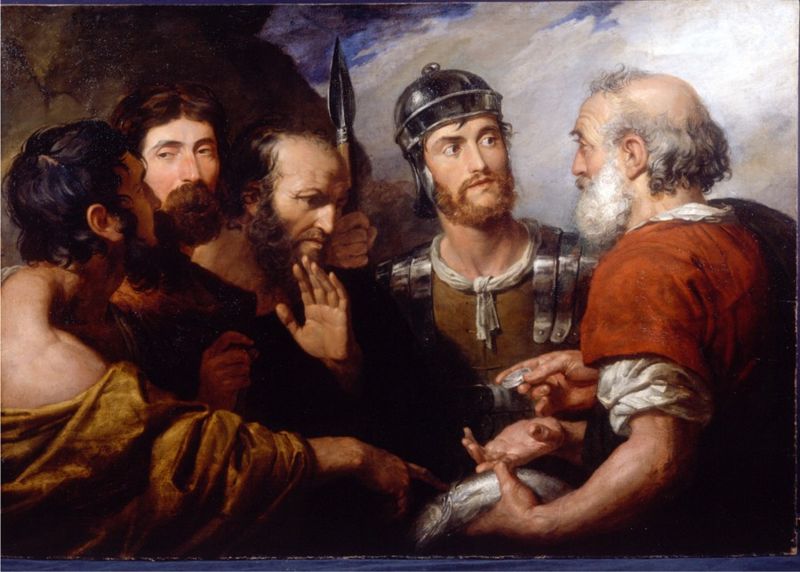
Encouraged by his patron, John Russell, 6th Duke of Bedford, he traveled to Italy to study in 1816. There he met Canova, who’s studio he attended while painting his portrait, where he absorbed Canova’s classical style. He is also believed to have learned sculpture from Canova at this time. Canova was Perpetual Principal of the Accademia di San Luca (Rome’s premier artistic institution) and doubtless put Hayter forward for honorary membership on the strength of his painting ‘The Tribute Money’ which was very favourably received in Rome. Hayter thereby became the Academy’s youngest ever member.
Returning to London in 1818, Hayter practiced as a portrait painter in oils and history painter. Dubbed ‘The Phoenix’ by William Beckford, Hayter showed a pomposity that irritated his fellow artists, but he mixed freely with many aristocratic families. His unconventional domestic life (separated from his wife, yet living with his mistress) set him apart from official Academy circles: he was never elected to the Royal Academy.
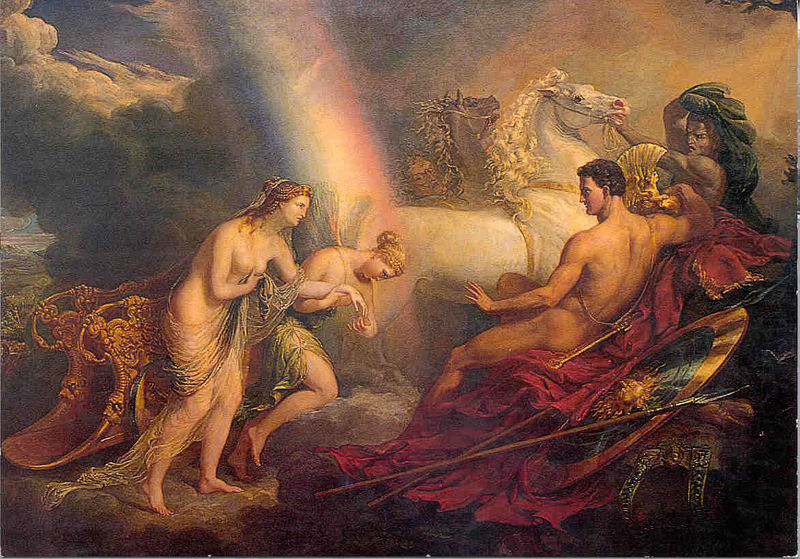
Hayter was most productive and innovative during the 1820s. George Agar-Ellis (later Lord Dover) commissioned the Trial of Queen Caroline in the House of Lords in 1820 (exh. 1823; London, National Portrait Gallery); painted on a large scale (2.33×2.66 m), Hayter’s first (and most successful) contemporary history painting revealed a taste for high drama effectively realised. In the Trial of William, Lord Russell, in the Old Bailey in 1683 (1825; Woburn Abbey) Hayter celebrated John Russell’s ancestry, in a work reminiscent of fashionable tableaux vivants of the country-house set.
In 1826 Hayter settled in Italy. The Banditti of Kurdistan Assisting Georgians in Carrying off Circassian Women (untraced), completed in Florence for John Proby, 1st Earl Carysfort, demonstrated Hayter’s assimilation of the style and exotic subject-matter of contemporary French Romantic art.
Returning to London in 1818, Hayter practiced as a portrait painter in oils and history painter. Dubbed ‘The Phoenix’ by William Beckford, Hayter showed a pomposity that irritated his fellow artists, but he mixed freely with many aristocratic families. His unconventional domestic life (separated from his wife, yet living with his mistress) set him apart from official Academy circles: he was never elected to the Royal Academy.
In 1827 his mistress, Louisa Cauty, died after poisoning herself with arsenic. Although it was apparently an accident, in a bid for attention, it was widely assumed that he had driven her to suicide, and he was forced by the scandal to move from Florence to Rome.
By late 1828 he was in Paris, where his portraits of English society members (some exhibited at the Salon in 1831) were stylistically akin to the work of recent French portrait painters such as François Gérard.
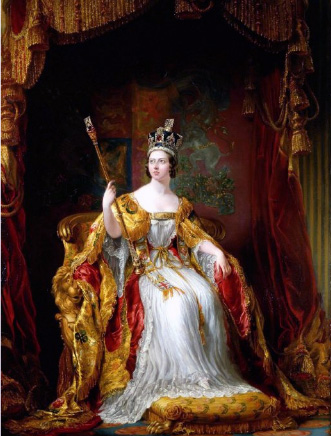
In 1831 Hayter returned to England. His grandiose plan to paint the first sitting after the passage of the Reform Bill resulted in Moving the Address to the Crown on the Opening of the First Reformed Parliament in the Old House of Commons, 5 February 1833 (1833-43; London, N.P.G.), for which he executed nearly 400 portrait studies in oil. Having painted the young Princess Victoria (1832-3; destr.; oil sketch, Brit. Royal Col.), Hayter was not a surprising choice as the new Queen’s Portrait and Historical Painter. On the death of Sir David Wilkie in 1841 Hayter was appointed Principal Painter-in-Ordinary to the Queen, which caused some annoyance at the Royal Academy as this appointment had historically been the preserve of the President, then Sir Martin Archer Shee. In 1842 Hayter was knighted. He painted several royal ceremonies including Queen Victoria’s coronation of 1837 and marriage of 1840 and also the Christening of the Prince of Wales of 1843 (all Brit. Royal Col.). He also painted several royal portraits including his most well know work the State Portrait of the new Queen Victoria, but because Albert preferred German painters such as F. X. Winterhalter, Hayter was eased out of royal circles.
By the mid-1840s Hayter’s portrait style was considered old-fashioned. He adjusted his type of history painting to suit the more literal taste of the early Victorian era (e.g. Wellington Viewing Napoleon’s Effigy at Madame Tussaud’s; destr. 1925; engraving, 1854). He also produced fluent landscape watercolours (many of Italian views), etchings (he published a volume in 1833), decorative designs and sculpture. The contents of Hayter’s studio were auctioned at Christie’s, London, on 19 April 1871.
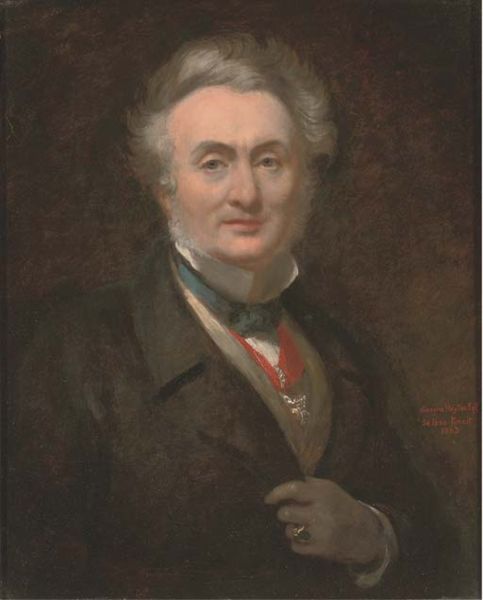
His younger brother, John (1800-95), was also an artist, known chiefly as a portrait draughtsman in chalks and crayons. The latter’s great-great-grandson was the influential printmaker Stanley William Hayter. Still wondering about a painting in your family collection? Contact us…it could be by Sir George Hayter.