Pierre-Auguste Renoir (1841 – 1919)
Get a Renoir Certificate of Authenticity for your painting (COA) for your Renoir drawing.
For all your Renoir artworks you need a Certificate of Authenticity (COA) in order to sell, to insure or to donate for a tax deduction.
Getting a Renoir Certificate of Authenticity (COA) is easy. Just send us photos and dimensions and tell us what you know about the origin or history of your Renoir painting or drawing.
If you want to sell your Renoir painting or drawing use our selling services. We offer Renoir selling help, selling advice, private treaty sales and full brokerage.
We have been authenticating Renoir and issuing certificates of authenticity since 2002. We are recognized Renoir experts and Renoir certified appraisers. We issue COAs and appraisals for all Renoir artworks.
Our Renoir paintings and drawings authentications are accepted and respected worldwide.
Each COA is backed by in-depth research and analysis authentication reports.
The Renoir certificates of authenticity we issue are based on solid, reliable and fully referenced art investigations, authentication research, analytical work and forensic studies.
We are available to examine your Renoir painting or drawing anywhere in the world.
You will generally receive your certificates of authenticity and authentication report within two weeks. Some complicated cases with difficult to research Renoir paintings or drawings take longer.
Our clients include Renoir collectors, investors, tax authorities, insurance adjusters, appraisers, valuers, auctioneers, Federal agencies and many law firms.
We perform Pierre-Auguste Renoir art authentication, appraisal, certificates of authenticity (COA), analysis, research, scientific tests, full art authentications. We will help you sell your Pierre-Auguste Renoir or we will sell it for you.
Best known for his paintings that depict people in candid, real-life compositions, especially the female nude, and scenarios that are pleasant, beautiful and giddy, French oil painter Pierre-Auguste Renoir is considered to be a founding member of the Impressionist movement. With his enthusiasm and determination to be distinctive, Renoir gave the movement a new flair by breaking from its contemporary style and combining it with more traditional, classicism.
His unique style of painting has made him one of the most famous painters of all-time, despite that some critics consider him overvalued. This is evident in a recent review of his work exhibited at the National Art Center Tokyo, where C.B. Liddell called him “one of the most overrated individuals to ever push a brush” in Metropolis Art & Entertainment magazine.
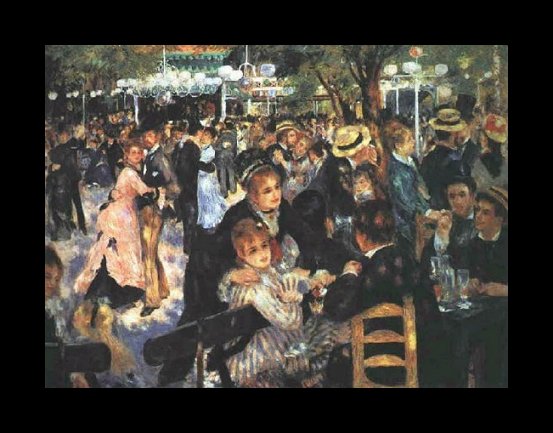
Despite this, Renoir continues to have a huge following and his artwork is of the most reproduced, such as his The Bathers and Nude in the Sun. His work is much sought after, selling for millions, with one of his best works, the Dance at Le Moulin de la Galette, painted in 1876 and depicting a large, outside gathering of people who are dancing, drinking and having fun, selling for $78.1 million in 1990.
Renoir’s use of the soft light fused with the placement of figures, his use of broken brush strokes and freely touched bright, vivid colors, his contrasting lines and his candid subject matter, largely of female figures, make his paintings easily identifiable. He drew inspiration from artists like Boucher, Fragonard, Watteau, Corot, Courbet and Manet.
Pierre-Auguste Renoir was born in Limoges, Haute-Vienne, France, on February 25, 1841, to a working class family. He began painting at 13 when he found a job as a porcelain painter in a Parisian factory. He was noticed for his talent at drawing, and was chosen to create flower designs on fine china, decorations on fans and wall hangings.
In 1862, he began studying art at the studio of Swiss Artist Charles Gleyre in Paris. There he met fellow students Alfred Sisley, Frederic Bazille and Claude Monet. Renoir and Monet began sketching on the Seine River banks together. They teamed up as they practiced painting light and water in the open air (en-plein-air), and realized that shadows are not brown or black, but a reflective color of the objects that surround them. This is known as diffuse reflection. With this in mind, they broke from the traditional way of painting, and within a few years developed their now famous technique of using light colors with quick brush strokes to define the then modern art form of Impressionism. One of Renoir’s best known Impressionist works that depicts an open-air scene is his 1876 Dance at Le Moulin de la Galette (Bal du Moulin de la Galette). The painting shows people crowded at a garden dance on the Butte Montmartre, which is close to where he lived.
In his studies, Renoir was influenced by a wide range of artists from various time periods, such as the realism of Edouard Manet and Gustave Courbet, the coloring of Eugene Delacroix, the luminosity of Camille Corot and the movement of Edgar Degas, as evident in his first paintings that resemble their styles. He frequently visited the Louvre museum where he studied the works of French masters such as Boucher, Fragonard and Watteau, which inspired him to create a classic form while retaining the bright-colored palette central to Impressionism.
The diversity of his tastes helped Renoir develop his technique of broken brush strokes and bright colors that portrayed light and movement. He also became good at illustrating facial expressions as he painted portraits of his young artist and writer friends. He enjoyed painting figures, of women in particular, which is what inspired him to paint works that capture real-life scenarios with pleasant, non-political themes.
In these early years, Renoir struggled and often could not afford paint. Further difficulties with family friends led to the loss of much-needed support and a favorite painting spot that was located near a scenic forest where he could no longer go. This resulted in a change of subject matter, when he turned to portraits in the late 1870s.
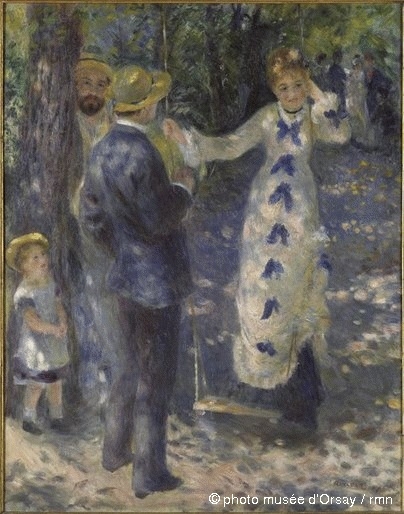
In 1864, Renoir had his first exhibition at the “Paris Salon,” but his work was still not well-known. It would be another 10 years before he was recognized, which came in 1874 when six of his paintings were hung in the first Impressionist exhibition. In the same year, two of his works were shown in London.
In his middle years, Renoir’s works were typically Impressionist compositions of real life, with bright colors and vivid light. However, in 1881 when Renoir traveled to Italy, Algeria and Madrid, he was further inspired by the works of Raphael and other Renaissance masters, such as Diego Velazquez, Eugene Delacroix, Titian and Rubens. After this, his art went in a new direction as he broke with Impressionism. He began to experiment with the more linear, disciplined and formal style of painting portraits, such as with his Bathers, 1884-87. It is said that Renoir used a palette of just five colors, having learned to combine colors when he was a porcelain painter.
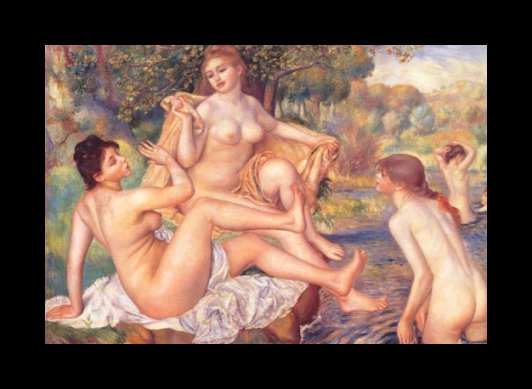
Renoir’s next few paintings were in a classic style, focusing on drawing and emphasizing figure outlines. This period in his career is known as the “Ingres period.” He focused on drawing and emphasized the outlines of figures, as the subject matter shifted from the contemporary to the more timeless. He also began to paint more nudes. While in Algeria, he came down with pneumonia that caused permanent damage to his respiratory system.
In Palermo, Sicily, on January 15, 1882, Renoir met the Composer Richard Wagner, and in 35 minutes was said to have painted his portrait. In 1883, he spent the summer in Moulin Huet, a bay in Saint Martin’s, Guernsey, one of the English Channel Islands, and in a little more than a month, produced 15 paintings that feature beaches, bays and cliffs.
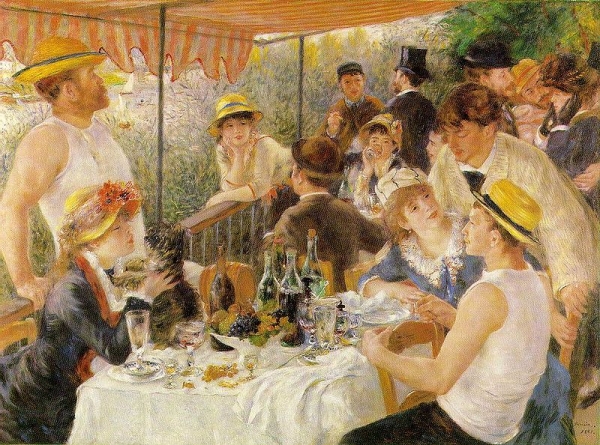
While studying his techniques, Renoir often used his fellow painters for his portraits. One of these was Suzanna Valadon, the subject of his The Bathers and Dance at Bougival, 1883. She later became a leading painter of the day. Another model was Aline Victorine Charigot, who in 1890 he married after already having a child with her, son Pierre in 1885. He used her for his Le Déjeuner des canotiers; Luncheon of the Boating Party, 1881.
They went on to have two more sons, Jean and Claude. Thereafter, Renoir painted many scenes that featured his wife and children, and even of the kids’ nurse, as well as of their family life.
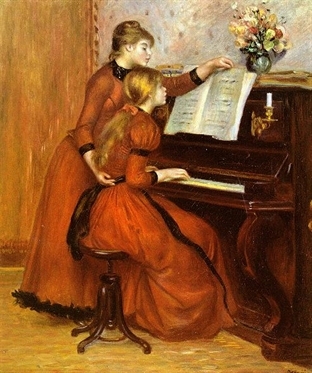
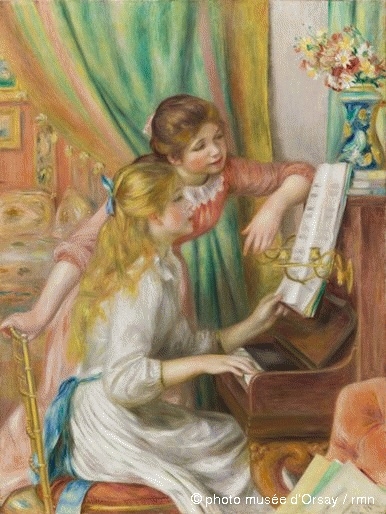
In the late 19th Century, Renoir changed his painting style yet again. He was less concerned with outlines and began using thin brush strokes, creating a sketchier look. One of his most successful works from this time was his Girls at the Piano, 1892 and Grandes Baigneuses, 1887.
In 1887, an associate of Queen Victoria requested Renoir donate several paintings to the “French Impressionist Paintings Catalog” in celebration of the queen’s Golden Jubilee. He was fast becoming one of the most famous artists of his time.
After developing rheumatoid arthritis in the last part of the 19th Century, Renoir moved to a farm at Cagnes-sur-Mer in 1907, which was a much-needed warm climate close to the Mediterranean Coast. He had great difficulty painting thereafter, and for the last 20 years of his life was severely limited in movement and bound to a wheelchair. His hands became progressively deformed and he developed problems with his right shoulder.
With all his physical ailments, however, Renoir continued to paint but had to adapt. He used assistants to place a brush in his hand and, as it is rumored, had a brush strapped to his fingers at times. To prevent skin irritation, his hands were wrapped in bandages. Renoir also used a movable canvas, called a picture roll, so he could paint with his limited mobility.
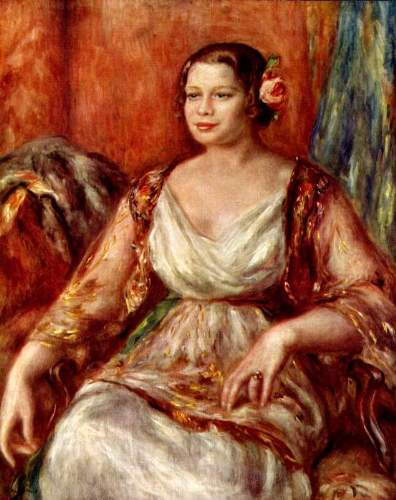
Despite his sufferings, with the help of Richard Guino, an upcoming artist, he began in a new medium, sculpture, with Guino working the clay. And yet again, during his later years, Renoir changed his style of painting. Now he began to use stronger colors with lots of reds and oranges, and thicker brush strokes. The female nude was still a favorite subject of his, and he detailed scenes with flecks of bright color that combined figures and their surroundings. His portrait of Austrian Actress Tilla Durieux, which he painted in 1914 just five years before his death and with limited physical ability, is a good example of his new use of color, such as on her shawl, and the classical pose.
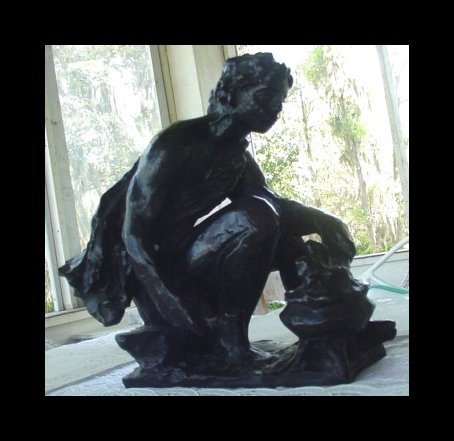
A bronze by Renoir we recently appraised
In 1919, Renoir visited the Louvre one last time to see his paintings that were now hanging there along with that of several old masters. On December 3, 1919, at the age of 78, Renoir died at his house in the village of Cagnes-sur-Mer. In that same year, a well-known art dealer named Ambroise Vollard published a book about the life and work of Pierre-Auguste Renoir, La Vie et l’Ceuvre de Pierre-Auguste Renoir. The book included some of Renoir’s etchings and watercolors and was signed by the artist. It was created on copper plates and numbered 1,000 copies. Later in 1986, Vollard’s heirs made reprints using the original plates.
In the years following his death, Renoir’s artwork has become famous and has sold for millions. Two of Renoir’s paintings sold for more than $70 million a piece, such as his Bal au moulin de la Galette that sold for $78.1 million in 1990. He was a prolific artist and made several thousand paintings over his lifetime. The largest collection of his works is at the Barnes Foundation in Philadelphia, PA, where there are 181 paintings in all.
If you have a painting that you think may be by Pierre-Auguste Renoir, we can research, appraise and authenticate it for you to make that determination. We issue certificates of authenticity (COA) and provide consultations for all your paintings and other artwork by Renoir. Contact us, we are the Renoir experts.